

ST THOMAS
CE PRIMARY SCHOOL

YEAr 3
Welcome to Year 3's Learning Page.
MEET THE TEAM


Mrs Appleton
Mrs McGregor
Mrs Dalby




Miss Farrell
Our Topic this term is:
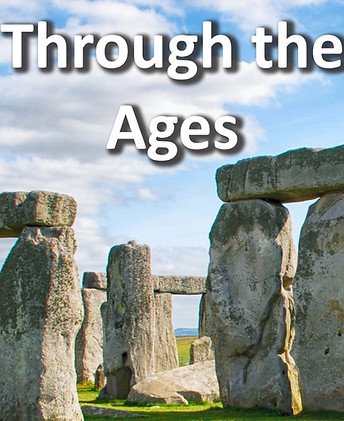

History Topic - through the Ages
Our first topic is Through the Ages. We will be learning about three different periods of British prehistory: the Stone Age, Bronze Age and Iron Age. We will discover terminology relating to time and sequence dates to make a timeline and explore the changes to people, homes and lifestyle throughout the different periods. We will investigate examples of prehistoric settlements, monuments, burials and artefacts in detail and also study how technology improved over time, including how the discovery of different metals changed the way that people lived.
Project Ideas
Here are some project ideas for you to carry out at home:
-
Create a timeline to put the following periods of prehistory into chronological
-
order: Bronze Age, Iron Age and Stone Age (including the three periods of the
-
Stone Age, Neolithic, Palaeolithic and Mesolithic). Use the internet or information
-
books to find the approximate dates for each period.
-
Use information books and the internet to find out about one of these aspects of Stone Age life: settlements, food, clothing, tools and weapons. Use your research to create an information poster about your chosen aspect. Include images and topic-specific vocabulary to make your information poster interesting for the reader.
-
Use the internet and information books to find images of artefacts from the Bronze Age. Use your existing knowledge and further research to create a table to provide information about some of the artefacts. Include an image or drawing of the artefact, the name of the artefact, its use and what it tells us about everyday life in the Bronze Age.
-
Use information books or the internet to find out about Iron Age hillforts. Draw an illustration of an Iron Age hillfort and label its features, such as a hill, ditches, high walls or guarded gates. Write a short explanation about each of the features that you have labelled.
-
The Iron Age people of Britain, known as the Celts, were fearsome warriors. Use the internet and information books to find out about Celtic warriors. Use your existing knowledge and research to draw a detailed illustration of a Celtic warrior and write a short paragraph to describe their beliefs, clothing, weapons and warfare.
Your home learning projects would look great on display, in the classrooms!
Upload your work and share it on SEESAW.

Maths
In Maths, we will be continuing with Addition and Subtraction. Then we will move on to working on methods of Multiplication and Division, doing this both mentally and using more formal written methods. This will be an important area of Maths for the children and we will be working hard on learning some new tables. The children can practise their times tables on TTRockstars to help them become more secure.
The overviews and lessons follow the White Rose Maths plans closely.
The link to their site with home learning and advice on can be found here:




English
In English, we will be looking at a variety of texts alongside our new scheme ‘I’m a Clever Writer’ to focus on recounts. In reading, we will read Stig of the Dump by Clive King, improving our reading and comprehension skills, answering questions on the text and analysing the text. We will be improving our fluency reading and comprehension skills by using our 5 stages of reading. Library is on a Tuesday.
Reading books should be in school every day
but will be changed (usually) on a Friday.

Science
In Science, we will be continuing to study Animal Nutrition and the Skeletal System. We will be planning and carrying out an investigation based on what we learnt about bones and muscles last half term.
Geography
In Geography, we will be looking at human and physical features of the UK and learning more about the countries and cities.

Art & Design
In Art and Design, we will be doing a project called Prehistoric Pots which teaches children about the artform of creating the pots made famous by the Bell Beaker folk in prehistoric times. We will also be looking at Cook Well, Eatwell in D&T. We will learn about methods of cooking and explore these by cooking taco fillings. We will design and make a taco filling according to specific design criteria.
PSHE
In PSHE, we will be learning how to recognise different emotions and understand how they can affect us. We will practise different ways to help ourselves feel calm and in control, build our own bank of strategies for managing strong feelings and learn how we can use these strategies when facing worries or challenging situations. In RE we will be looking at Salvation and considering why Christians call the day Jesus died ‘Good Friday’. In music, we will learn that singing often draws communities together to tell stories, comment on history, share happy or sad times and to worship.
PE
This half term in PE we will complete the Dance: my word links to language unit. This units will use different techniques to respond to a stimulus and communicate a mood or atmosphere by applying dynamics. They will need to come in their P.E. kits on Mondays and Fridays.
We will be using the OAK academy for our music and will begin with 'Start with singing: finding my singing voice'. This unit helps pupils to discover the difference between their speaking, or chanting, and singing voice.
Home / School reading book - We change every Friday and return them Every Thursday
PE - Our PE days are on Mondays and Fridays. Come to school dressed in your correct PE Kit (School house T-shirt, school cardigan / jumper, plain black or navy shorts, leggings or joggers, black / dark coloured trainers / pumps)
Library Books - Our Library day is Tuesday. Return and change books when you have finished reading them.
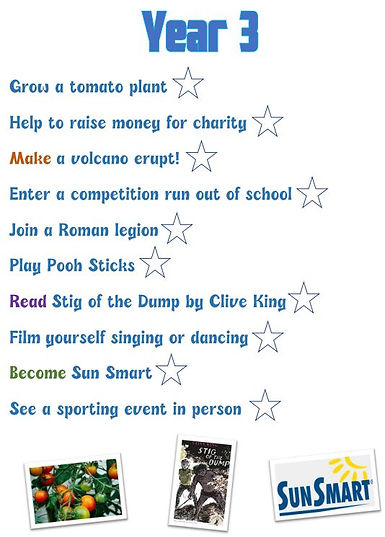
Here is your Year 3 Class Charter challenge sheet.
Don't forget that we are always at the end of an email (year3@stthomas.org.uk) and most afternoons in the playground - at the end of the day when the children leave.